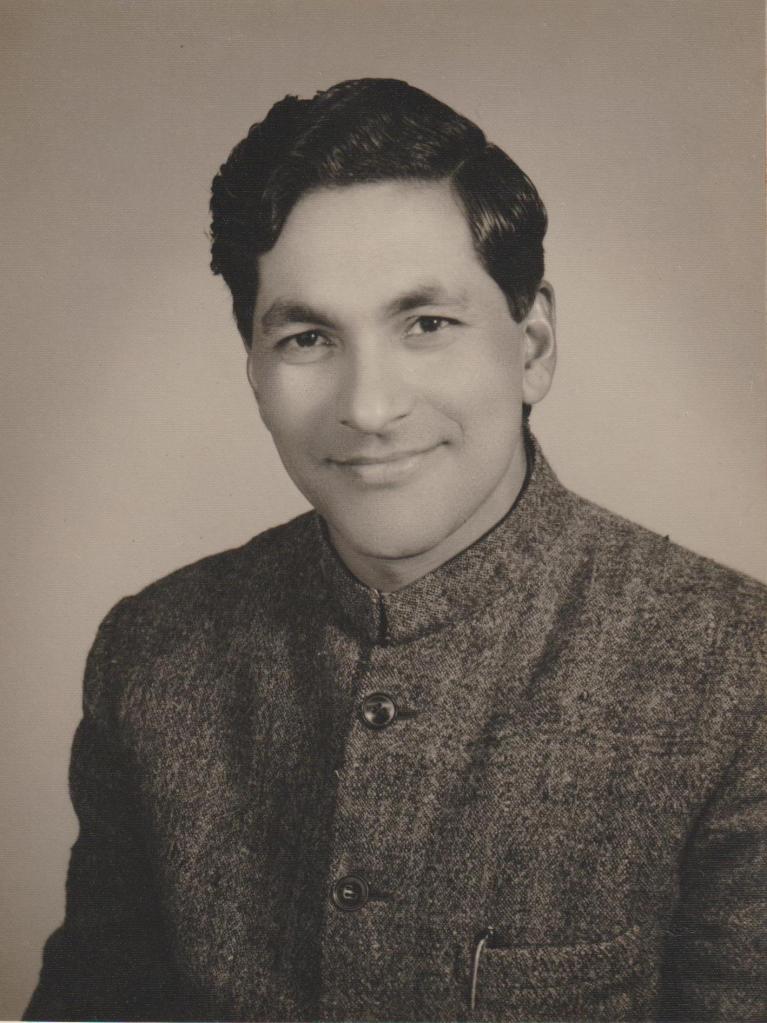
Late Shri Pratap Bhaiya was an embodiment of the confluence of earnest nationalism and unwavering dedication to societal upliftment during the turbulent British era. The winds of change that swept through the Kumaon and Garhwal regions of India saw a surge of young minds studying in the esteemed educational hubs of Allahabad, Lucknow, Banaras, and Calcutta. These young men, enlightened by their newfound knowledge, were instrumental in awakening a collective consciousness that ignited the flames of the national movement. It is thanks to such patriots, who sacrificed their lives for our freedom, and to visionary leaders like Shri Pratap Bhaiya, who guided society toward progress, that India has seen development across various domains.
Born on 10th December 1930 in the humble village of Chyurigad, Shri Pratap Bhaiya’s early life was steeped in simplicity and forthrightness. He inherited a legacy of struggle and service from his father, Aan Singh, a District Board member during the tenure of Pandit Govind Ballabh Pant and a soldier of the freedom struggle who was deeply influenced by Mahatma Gandhi’s philosophy. Education was a scarce resource in his native place, compelling young Pratap Bhaiya to pursue his studies at Junior High School Okhalkanda and later at Narayan Swami High School, Ramgarh. It was here, under the tutelage of the revered social reformer and saint Narayan Swami, that Pratap Bhaiya imbibed the values of humanity and noble manhood.
In 1947, he enrolled in the Government Inter College, Nainital, where he excelled in debates, clinching first place in three Hindi and one English debate. His excellence was recognized with certificates presented by Bharat Ratna Pandit Govind Ballabh Pant. He then furthered his education at Lucknow University, earning degrees in B.A., M.A., L.L.B., DPA, and ITD. It was during this period that he came under the profound influence of the Vice-Chancellor, the erudite socialist Acharya Narendra Dev, whose ideals of simplicity and high-mindedness left an indelible mark on him.
Shri Pratap Bhaiya’s entry into the political arena was a natural progression of his active involvement in student politics. His political philosophy was rooted in value-based governance, and his commitment to the nation’s development was evident in his various roles. In 1957, he was elected as the youngest MLA from the Tanakpur-Jehanabad constituency in the Uttar Pradesh Legislative Assembly. His re-election in 1967 saw him assume the mantle of the youngest Cabinet Minister from the Kumaon region, an unprecedented achievement. In the government of Chaudhary Charan Singh, he briefly oversaw cooperation and excise departments, but it was as Health Minister that he truly made his mark, leaving an enduring legacy as a capable administrator.
For Shri Pratap Bhaiya, education was not merely a tool for literacy but a means to inculcate human values and halt the erosion of morality in a rapidly changing world. He envisioned a system of education that would permeate rural areas, fostering self-reliance and poverty alleviation. To this end, he established the Acharya Narendra Dev Siksha Nidhi, which led to the founding of over 100 schools across villages, including Tharu Inter College Khatima (July 1959), Bhartiya Shaheed Sainik Vidyalaya Nainital (July 1964), and Rashtriya Shaheed Sainik Smarak Vidyapeeth Nainital (June 28, 1987). His efforts to illuminate the remote corners of Uttarakhand through education earned him the epithet of “Madan Mohan Malviya of Uttarakhand.”
Shri Pratap Bhaiya’s contributions extended beyond education; he was a beacon of hope, offering guidance for addressing societal issues and invoking a sense of national and global welfare. His life of selfless service, devoted entirely to the upliftment of society, has immortalized him in the annals of Indian history as a luminary whose legacy continues to inspire generations.
 Journal of Acharya Narendra Dev Research Institute