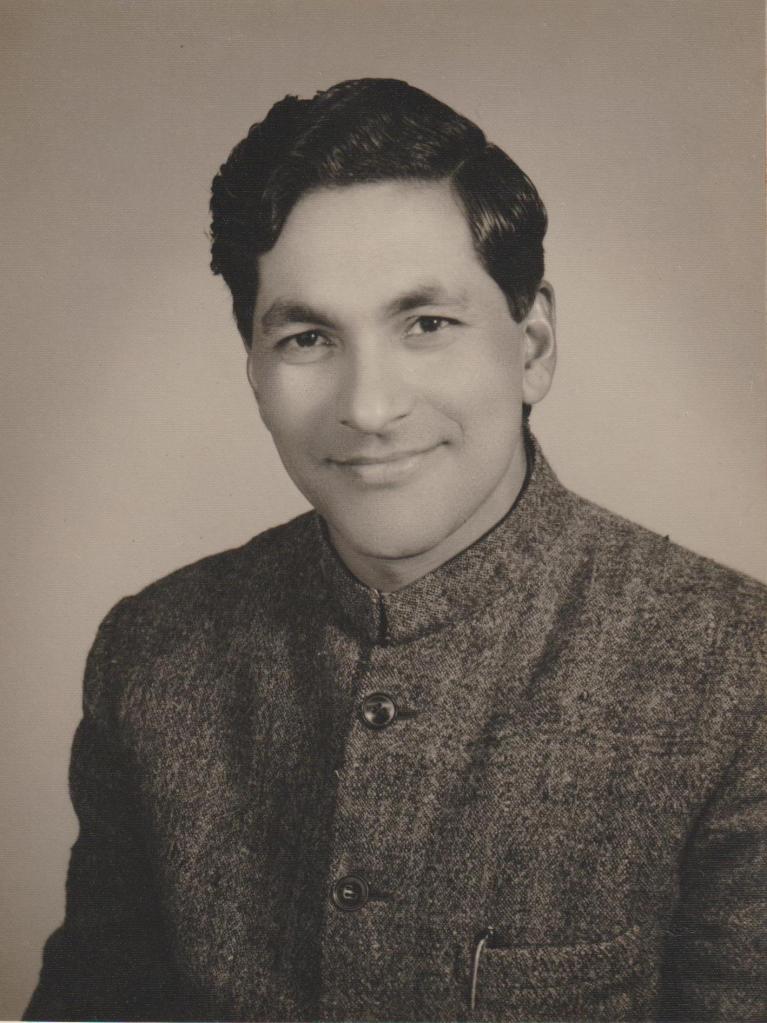
Shri Pratap Bhaiya: The Luminary of Himalayan Resolve and National Renaissance

Late Shri Pratap Bhaiya was an embodiment of the confluence of earnest nationalism and unwavering dedication to societal upliftment during the turbulent British era. The winds of change that swept through the Kumaon and Garhwal regions of India saw a surge of young minds studying in the esteemed educational hubs of Allahabad, Lucknow, Banaras, and Calcutta. These young men, enlightened by their newfound knowledge, were instrumental in awakening a collective consciousness that ignited the flames of the national movement. It is thanks to such patriots, who sacrificed their lives for our freedom, and to visionary leaders like Shri Pratap Bhaiya, who guided society toward progress, that India has seen development across various domains.

Born on 10th December 1930 in the humble village of Chyurigad, Shri Pratap Bhaiya’s early life was steeped in simplicity and forthrightness. He inherited a legacy of struggle and service from his father, Aan Singh, a District Board member during the tenure of Pandit Govind Ballabh Pant and a soldier of the freedom struggle who was deeply influenced by Mahatma Gandhi’s philosophy. Education was a scarce resource in his native place, compelling young Pratap Bhaiya to pursue his studies at Junior High School Okhalkanda and later at Narayan Swami High School, Ramgarh. It was here, under the tutelage of the revered social reformer and saint Narayan Swami, that Pratap Bhaiya imbibed the values of humanity and noble manhood.

In 1947, he enrolled in the Government Inter College, Nainital, where he excelled in debates, clinching first place in three Hindi and one English debate. His excellence was recognized with certificates presented by Bharat Ratna Pandit Govind Ballabh Pant. He then furthered his education at Lucknow University, earning degrees in B.A., M.A., L.L.B., DPA, and ITD. It was during this period that he came under the profound influence of the Vice-Chancellor, the erudite socialist Acharya Narendra Dev, whose ideals of simplicity and high-mindedness left an indelible mark on him.

Shri Pratap Bhaiya’s entry into the political arena was a natural progression of his active involvement in student politics. His political philosophy was rooted in value-based governance, and his commitment to the nation’s development was evident in his various roles. In 1957, he was elected as the youngest MLA from the Tanakpur-Jehanabad constituency in the Uttar Pradesh Legislative Assembly. His re-election in 1967 saw him assume the mantle of the youngest Cabinet Minister from the Kumaon region, an unprecedented achievement. In the government of Chaudhary Charan Singh, he briefly oversaw cooperation and excise departments, but it was as Health Minister that he truly made his mark, leaving an enduring legacy as a capable administrator.

For Shri Pratap Bhaiya, education was not merely a tool for literacy but a means to inculcate human values and halt the erosion of morality in a rapidly changing world. He envisioned a system of education that would permeate rural areas, fostering self-reliance and poverty alleviation. To this end, he established the Acharya Narendra Dev Siksha Nidhi, which led to the founding of over 100 schools across villages, including Tharu Inter College Khatima (July 1959), Bhartiya Shaheed Sainik Vidyalaya Nainital (July 1964), and Rashtriya Shaheed Sainik Smarak Vidyapeeth Nainital (June 28, 1987). His efforts to illuminate the remote corners of Uttarakhand through education earned him the epithet of “Madan Mohan Malviya of Uttarakhand.”

Shri Pratap Bhaiya’s contributions extended beyond education; he was a beacon of hope, offering guidance for addressing societal issues and invoking a sense of national and global welfare. His life of selfless service, devoted entirely to the upliftment of society, has immortalized him in the annals of Indian history as a luminary whose legacy continues to inspire generations.

75 Years of Independence: Nation First, Always

by- Utkersh Bora, Science Editor, J.A.N.D.R.I.

This year marks the 75 years of independence of India and is being celebrated throughout the country as “Azadi ka Amritotsav”. It was on this day, back in 1947, that India took its first baby steps to become one of the largest democracies in the world, overcoming a plethora of challenges to earn global recognition. India has come a long way since, leaving behind a string of landmarks that define its journey from the agony of Partition to a strong and powerful nation.

In its 75 years of independence, India has added countless achievements to its credit. It has built a modern economy (second fastest growing economy), remained a democracy, lifted millions out of poverty, has become a space and nuclear power and developed a robust foreign policy. Despite all that we have achieved in the past years, we seldom hear that the young generation has lost the love for the nation. Through this post, I’d like to address what the Indian nation truly stands for.

“India is my country and all Indians are my brothers and sisters. I love my country and I am proud of its rich and varied heritage.”

When we say we love India, and someone asks us, “What exactly do you love?” What’ll your answer be? Beyond the area marked on a map, what does India mean to you? How do you communicate it to, let’s say, a Dutch national? How do you communicate it? It is quite possible that your answer is masala dosa. Maybe you have a few other things, like Bollywood, the bhangra, the cow—the cow sitting in the middle of the highway that is—the monkey riding the elephant, peeing by the roadside, no? You’d say, “Mahatma Gandhi!” or you’d probably talk of the colours of Holi, or you’d probably talk of the Diwali lights. These are all good, nice, vibrant images of the Indian landscape. Can you fall in love with these? I mean, it’s not so easy loving masala dosa, or is it?

A nation at its root represents a community of people united through certain values. For someone to really love our nation, it is important that we firstly know what those values are. Those values must be worth loving, and even more fundamentally, cannot be just theoretical, ideals on paper.

When we say that youngsters of today have lost love for the nation, what exactly have they lost love for? Do they know what the Indian nation stands for, and do they know what is worth loving?

A nation does not become admirable or respectable or lovable just by its geographical boundaries and political governance. There are nations that have been founded on hatred towards a group of people? They exist because of a certain dislike towards something. We have had nations in history that existed just to obliterate other nations, and we have had nations where the connecting thread is as fragile as a shared language, shared ethnicity, shared food habits. So, a nation is not necessarily lovable on its own. I’d like to quote some words from Swami Vivekanand’s speech here:

“Civilizations have arisen in other parts of the world. In ancient and modern times, wonderful ideas have been carried forward from one race to another…But mark you, my friends, it has been always with the blast of war trumpets and the march of embattled cohorts. Each idea had to be soaked in a deluge of blood….. Each word of power had to be followed by the groans of millions, by the wails of orphans, by the tears of widows. This, many other nations have taught; but India for thousands of years peacefully existed. Here activity prevailed when even Greece did not exist… Even earlier, when history has no record, and tradition dares not peer into the gloom of that intense past, even from until now, ideas after ideas have marched out from her, but every word has been spoken with a blessing behind it and peace before it. We, of all nations of the world, have never been a conquering race, and that blessing is on our head, and therefore we live….!”

– Swami Vivekanand (Indian Philosopher)

It is not our Geographic boundary, the LOC, and the ruling parties that make India a nation, it is the people who live here and the beliefs that we all share. Any attempt at defining our nationhood in terms of dogmas and identities of religion, region, hatred and intolerance will only lead to dilution of our national identity. There are several founding principles or common values that makes India, India. Some of these values include:

• Tyaga, which is renunciation

• Dana, which is liberal giving

• Nishtha, which is dedication

• Satya, which is truth

• Ahimsa, which is non-violence

• Sehensheelta, which is forbearance (the quality of being patient and sympathetic towards people, especially when they have done something wrong)

Respect is an extremely valued component of the everyday life of people in India. Children are taught from a very young age to always respect their elders. Even as adults, the elderly are still at the top of the totem pole. Children take care of their parents once they are adults, and their parents will most likely live with them until their lives have ended.

Family is also an extremely important component of Indian culture. Families are valued highly and are a part of an individual’s life until death. Often when people get married, they take in their older relatives and other relatives and provide support of them.

We as Indians seek harmony throughout life, and we all share these values in our everyday lives. These are the values that make us fall in love with our nation.

Today Western influence is rising on the Indian society by leaps and bounds and its intensity is rising with the passing of each year. The Indian values which is one of the oldest and richest culture is under threat as western culture is establishing its strong base in India and gradually wiping out the Indian culture. Slowly all our values for which India has its pride are vanishing. People are following the western culture without knowing its consequences.

The concept of joint families is abating. Western food is replacing the Indian food which has increased the rate of obesity in India. Children are affected by this westernization as they are not getting the care and love from their grandparents as they have moved to the old age homes.

There is no harm in taking good things and gaining knowledge about other cultures and traditions. No doubt western culture is versatile and has taught us to be self-dependent but this does not have to happen at the expense of centuries old values.

We should feel proud that we are Indian and have such a rich cultural heritage which is rare. Mahatma Gandhi once said,” The culture of a nation resides in the souls and the hearts of its people”. The Indian values do not require protection, but it requires practice. Each of us should commit ourselves to this cause and spread these values through practice. Do as much as you can, and do things wisely. Don’t get identified with it, don’t become its patriot. Share as much as you have experienced and understood. Existence will take care of everything.

Decolonising Indian Minds

Dr. Hariom Prakash Singh

Associate Professor, Government Degree College, Muwani, Pithoragarh

The greatest event of world history in the 20th century has been the event of decolonization, which began just after the Second World War. The world-wars in quick succession had weakened the colonial powers and they were finding it hard to stretch their resources to far off lands. This allowed the colonized countries to break the bondage, not to say about the nationalist movement which was encouraged by the western concept of liberty, equality, and right to self-determination. Colonialism ended in the traditional sense but it continued in various forms i.e. neo-colonialism, imperialism, ideological hegemony, etc. It is in this background that we need to understand our culture and rich heritage.

We need to prevent colonial influence while studying India; we should rather focus more on what happened in the last 5000 years rather than just the 19th century. Did you know that in 1661 the islands of Bombay were given in dowry to King Charles II of England when he married Catherine de Braganza of Portugal? It was only in 1920 that women in the U.S. earned the right to vote & contest, whereas Indian women were given a higher status long before. Orientalists might also have been the agents of colonial projects. These studies do not necessarily mean that they came here to know about our societies but also to interpret the society in a way that suits colonization. The imperialist had essentially based their modus-operandi in governance and administration on the pursuance of their colonial interests.

Two centuries of colonial rule has left an indelible impact on our Indian society ranging from the way people walk, talk, and dress to how society is regulated by rules, laws, and directions. Foreign rulers redefined India’s social, cultural, and political landscape. As a result, we, the followers of Dharma have become defensive on certain issues and importantly several misconceptions have arisen in our minds. Because of this, we are forever measuring ourselves against western concepts without knowing and understanding the Indian one.

The fact that today English is the lingua franca of India shows the influence that the British had as the colonial rulers of India. The education system right from KG to PG was patterned based on the report of Lord Macaulay. Many laws that regulate the lives of Indians today were formed during the colonial rule ranging from the Indian penal code to the constitution and the criminal penal code. The political system prevalent in India is also a reflection of colonial influence. India’s founding fathers were trained in parliamentary politics and hence found it comfortable to follow it after independence.

The British governance and administration gave birth to a new middle class, who were educated and trained in colonial culture. These people were Indian in blood but British in thought. This elite culture continued even after independence because we were unable to dismantle British laws and administration. Civil-services are still holding strong and running the government. It is still a dream job for every aspiring student. The exploitative administration which was put in place by the Britishers continued as we were unable to provide any indigenous system as an alternative. Feudalism which impeded the growth of our spiritual and cultural ethos continued in a new form.

Now the question arises what went wrong with us in our development that we lost the initiative of the ancient era to the western world. We need to be careful while analyzing our past and comparing it with the civilizations of the western world. Till the advent of the Renaissance in Europe India and the western world were more or less at par with each other. The medieval period which symbolized feudalism and primacy of religion impeded the growth of new energies and thought and thus old structures remained entrenched.

Renaissance in Europe released the mind of its old fetters and destroyed many idols that it had cherished, a new spirit of objective inquiry was making itself felt, a spirit which not only challenged old established authority, but also abstraction and vague speculation. On the other hand, Asia has become dormant, exhausted, as it were by its past efforts. Europe, that was backward in many ways, was on the threshold of vast changes. It is here where India lost its inner vigor and was slowly overpowered by the Britishers.

One of the reasons for India’s limited progress is that post-independent India is at odds with its true nature. It is a Dharma Yudh between secular /colonial India vs Dharma/Bharat. From time immemorial, the great aim of human endeavor in India was Dharma, Artha, Kama, and Moksha (roughly translated as righteousness, wealth, worldly pleasures, and salvation). While Artha has a much wider significance than merely wealth, making profit was never a dirty word. What mattered was how the wealth was earned and spent.

When a nation of human being behaves in a manner i.e. alien to their inner nature, long term progress is impossible. The day Indians are guided by Indian thought will be the day when India will be truly free. I am inspired by these words of swami-Vivekananda,”India must conquer the world and nothing less is my ideal”. Our eternal foreign policy must be the export of the Shastras to the nations of the world. One of the reasons for India’s downfall was that she narrowed herself, went into a shell, as the oyster does, and refused to give her treasures and jewels to the other races of mankind outside the Aryan fold.

We need to seek our identity in our past that is the Vedic era. This past is something not to be contemplated but to be felt, not only in their thinking but should also reflect in their writings. The past should be dug up with all its roots and then felt in the bloodstream. Our country has three names, Bharat means the land of Knowledge, Hindustan means the Hindi speaking areas of the Indian subcontinent, the word ‘India’ is of Greek origin, who probably gained their first idea of India from Persians, dropped the hard aspirate and called Hindus ‘indoi’. Dr. Radhakrishnan wrote ‘The people on the Indian side of the Sindhu were called Hindu by the Persians and the later western invaders’. The term ‘Hindu ‘ according to Dr. Radhakrishnan had originally a territorial and not a creedal significance. It Implies residence in a well defined geographical area.

When we say knowledge it means about the inner self and its relationship to the external world. (Hindustan, Hindu, and Hindi). Western democracy is based on the rights and duties of man. It cherishes ideas of freedom, equality, and fraternity. Dharma is the Indian conception of the way of life and conduct. In Dharma rights and duties lose the artificial antagonism created by views of the world, which makes selfishness the root of action and regains their deep and eternal unity.

Dharma is the basis of democracy which Asia must recognize, for in this lies the distinction between soul of Asia and soul of Europe. Democracy is here to stay in India but what is needed is a change in attitude. Most interpret the meaning of world “right” as what is in it for me. Dharma is about practicing righteousness at all times. It is where rights and duties lose their relevance. Instead, then it is a transformation from asking what you can do for me to what I can do for you. When one removes I and Me from one’s mind, one eliminates ego and hatred towards fellow human beings.

What is religion? Sri. Aurobindo wrote, “There is no world as plastic and uncertain in its meaning as the word religion.” Religion is a Semitic concept, believing in a historical prophet and living by a holy book. Thus a combination of Jesus and the Bible or Mohammed and the Quran establishes the distinct identity of Christianity and Islam. According to them, salvation is possible only if you accept the authority of their prophet and holy book.

Conversely, Hinduism does not have a prophet or a holy book and does not claim that one can achieve self-realization through only the Hindu way. Open-mindedness and simultaneous existence of various schools have been the hallmark of Indian thought. We are so influenced by western thought that we created religions where none existed. Today Hinduism, Buddhism, and Jainism are treated as Separate religions when they are different ways to achieve self-realization. We need to disengage ourselves from the western world. We shall not let our culture to stand like an accused in an alien court to be tried under alien law. We shall not compare ourselves point by point with some western ideal, to feel either shame or pride —we do not wish to have to prove to anyone whether we are good or bad, civilized or savage (world —– that we are ourselves is all we wish to feel it for all we are worth).

During the independence struggle, Gandhiji was largely successful because he did not descend from the top, he seemed to emerge from millions of India, speaking their language and incessantly drawing attention to our rich philosophical and cultural heritage. He was essentially a man of religion, a Hindu to the inner-most depth of his being, and yet his conception of religion had nothing to do with any dogma or custom of ritual. Indian ‘culture’ he wrote is neither Hindu, Islamic nor any other, wholly. It is a fusion of all. Again he said ‘I want the culture of all lands to be blown about my house as freely as possible. But I refuse to live in other peoples house as an interloper, a beggar, or a slave’. Influenced by modern thought and current, he never let go of his roots and clanged to them tenaciously.

He thus set about to restore the spiritual unity of the people and to break the barrier between the small westernized group at the top and the masses, to discover the living elements in the old roots and to build upon them, to weaken the masses out of their stupor and static condition and make them dynamic. In his single track and yet many-sided nature the dominating impression that one gathered was his identification with the masses, a community of spirit with them, an amazing sense of unity with the dispossessed and poverty-stricken not only of India but of the world. Even religion as everything else took second place to his passion to raise these submerged people.

A semi-starved nation can have neither religion nor art nor organization. Whatever can be useful to starve millions is beautiful to my mind. Let us give today the first vital things of life and all the graces and ornaments of life will follow. I want art and literature that can speak to millions. These unhappy dispossessed millions haunted him and everything seemed to revolve around them ‘for millions it is an eternal vigil or an eternal traces his ambition he said was ‘to wipe every tear from every eye’.

Gandhi challenged the western world and colonial ethos by digging deep in the roots of Indian culture and philosophical values, mending and changing them according to the demand of time. He discarded castes based society and other dogmas prevalent in India at his time. He was not an idol worshipper yet he was deeply religious. Religion means purity, spiritualism, right means, detachment, and sacrifice. Western concept of secularism, industrialization, atheism, and economic development never appealed to him. He gave his concept of secularism, economic development, cottage industry, society, and religion. He not only preached Indian culture and values but practiced them in front of the world and in the process, he broke the hegemony of colonial ideology and western superiority and subdued them with the Indian concept of detachment, truth, self-belief, and renunciation.
Empowering Indian Muslim Women by criminalizing Triple Talaq

Hasibur Rahaman Molla

Department of Geography,

Sivanath Sastri College,

Kolkata, India

Muslim women suffer from challenges comprising education, livelihood, health care, etc. They lag behind in almost all key socio-economic indicators of development. Additionally and very importantly the Indian Muslim women face hardship in marriage and family emanating from the rampant misinterpretations of Quranic tenets related to marriage and divorce. Bharatiya Muslim Mahila Andolan (BMMA) reported that since 2007 they have come across numerous cases of verbal talaq rendering Muslim women destitute. BMMA has been working on numerous accounts of Muslim women being divorced overnight and separated from their children as their husbands chose to unilaterally say ‘talaq’, ‘talaq’, ‘talaq’. In most cases, the husband’s mindset as well as the action is dictated by a commonsensical understanding that the husband enjoys the ‘right’ given by Islam to divorce his wife just by saying ‘talaq’. Hardly there is any awareness about Quranic injunctions or the real meaning of ‘talaq’. However, the Indian Government has criminalized the triple talaq by an act of parliament on 1st August 2019.

Introduction

The practice of instant triple ‘talaq’ (uttering ‘talaq’, ‘talaq’, ‘talaq’ at a time) to divorce a woman by her husband is the misinterpretation of Quranic guidelines. ‘Talaq’ (divorce) should be the last resort of believing Muslims if there is serious marital discord. Nowhere in the Holy Quran, it is mentioned that triple ‘talaq’ at a time will be considered as ‘talaq’. The Prophet said, “The most hateful permissible thing in the sight of God is divorce” (Abu Dawud: 1863). But when the situation is such that the couple can’t stay together, then the ‘talaq’ is desirable. Quran (3:34) advises the husband to reason out (Faizuhunna) with his wife through discussions. If differences persist the couple is directed to keep sexually distance themselves (Wahjuruhunna) from each other in the hope that this temporarily physical separation may encourage them to reunite. And if it fails, the husband is said to once again explain (Wazribuhunna) to his wife about the seriousness of the condition so that there is a possibility of reconciliation. If the differences persist, the Quran (4:35) instructs the matter to be put before two persons (arbiters), one from the family of each spouse to provide reconciliation efforts.

After the failure of the above mentioned four attempts to unite them together, the Quran allows first ‘talaq’ to be uttered and followed by a waiting period of the three months. This waiting period is called Iddah. Not more than tow ‘talaq’ can be pronounced within this period. If the husband and wife are unable to reconcile during Iddah, the final ‘talaq’ can be pronounced in the presence of two witnesses but only after the expiry of the Iddah. Even after the Iddah has lapsed, the Quran offers the challenging parties a chance to reunite, provided the final talaq has not been pronounced. Once the final ‘talaq’ has been pronounced the break up in the marital is taken place and the parties are considered as divorced.

Religious Freedom versus Universal Rights in India

Since independence, India is staggering with the issue. Our constitution has enshrined both universal rights and religious freedom. Article 15 of the Indian Constitution says “the state shall not discriminate against any citizen on grounds only of religion, caste, sex, place of birth or any of them. Article 26 of the Indian Constitution has given the people the freedom to manage their respective religious affairs. It (Art. 26- b) says “subject to public order, morality, and health, every religious denomination or any section thereof shall have the right to manage its affairs in matters of religion”. We have a plurality of faith and belief and the plurality of cultures amongst us. Seeking to accommodate multiple faiths, India’s law for marriage, divorce, and inheritance related matters are deemed to be ‘Personal Law’ and are left largely up to the respective religion. The practice of instant triple talaq simply violates the fundamental rights of the Indian constitution as the constitution does not allow women to be treated differently. According to Yusuf Muchhala, a lawyer of All India Muslim Personal Law Board, the religious freedom nowhere means a free license to the male of the Muslim community to subjugate the woman.

Triple Talaq and All India Muslim Personal Law Board

The practice of triple talaq is illegal in many Muslim majority countries, but in India, it was permitted (before 1st August 2019) under the Muslim Personal Law (Shariat) Application Act, 1937. According to this Act, in matters of personal disputes, the state will not intervene and religious authority will instead pass the judgments. (Al Jazeera, 2016). All India Muslim Personal Law Board (AIMPLB) has been set up in 1973 as a custodian of Muslim Personal Law. It wants to impose the Shariat laws on the Muslim community in India and the focus of this organization is to educate the Indian Muslim and built awareness on the protection and application of Islamic laws. This law has made the Muslim community stuck in a time warp and the subsequent laws like the Dissolution of Muslim Marriage Act of 1939 and the Muslim Women (Protection of Right on Divorce) Act of 1986 had not been able to move the community away from discrimination shown to Muslim women (The Hindu, 2016).

Conclusion

Instant triple talaq in the Muslim community is malpractice to give divorce to a woman by her husband arbitrarily. This type of one-sided divorce without any effort to reconcile is neither formulated in the Quranic guidelines nor supported by the Indian Constitution. It is due to the misinterpretation of Quranic guidelines by some clerics, the Muslim women are facing great adversaries in their marital as well as natal lives. Indian Muslims do not have codified Shariat Laws that adequately address all aspects concerning marriage and family matters. The conservative sections are unaware and unconcerned about the issues of Muslim women and therefore they cannot continue speaking for them. By recognizing only the conservative religious voices the democratic state has also failed in enabling fair representation for all sections of the population including women. Regarding marital disputes, the triple talaq is banned in several Muslim majority countries. Therefore, in India, the practice of instant triple talaq as a means to divorce cannot continue when the era is confronted by modern conceptions of justice and rights, and the ideals of universal human rights, equality, and personal freedom.

UTTARAKHAND’S STATE MOVEMENT: A Historical Study

Dr. Shivani Rawat (Assistant Professor, History Department, D.S.B.Campus, K.U. Nainital)

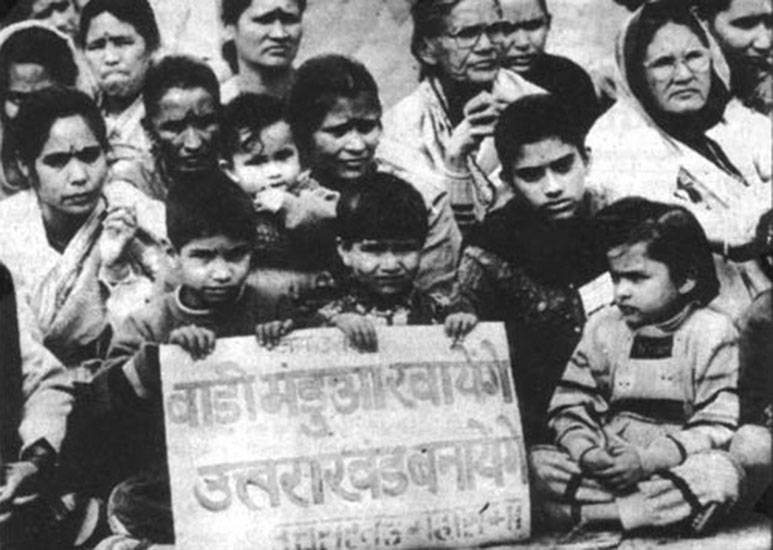
Uttarakhand’s state movement arose with the problems of poverty, backwardness, tough routine of the folks of the hilly areas and the total ignorance by the government. The demand for the state of Uttarakhand was not instantaneous, in fact, it had to pass through a long chain of a struggle for its existence. Although the geographical complexities presented some obstacles in the expansion of various movements, nevertheless it did not affect the political and social awakening among the people. During the British period, a voice was raised against this exploitation from time to time. After the independence, many hardworking and active personalities proved themselves in the field of politics while contributing their leadership but the development of the complex geographical, economical and social circumstances of the region could not be done.


The demand for the separate state of Uttarakhand was important not only for its unique cultural & geographical status but also for the regional development in education, health, agriculture, trade and industry, the areas of which remained untouched by the Lucknow Government.  The intellectual class of this region who had struggled their way through these difficulties demanded for the first time, the establishment of a separate state in 1923. A letter addressed to the governor of Joint Province plead that the region of Uttarakhand should be recognized as a separate unit. In 1928 the Nehru committee recommended that the division of the states should be based upon the choice of the public and on the basis of their geographical, economical & financial concepts.


A special political conference of the Congress was held on 5-6 May 1938 in Srinagar Garhwal. In the conference, the demand for a separate political arrangement for this hilly area was raised and it was suggested that the hilly folks should be given the right to flourish their cultural values. In 1948, the Dur Commission presented a report regarding the terms and conditions to be obeyed for the establishment of a new state. The terms included factors such as geographical continuity, financial independence, the possibility of development in the future and the concept of similar language.

In 1952 the minister of the Communist Party P.C. Joshi pleaded the Indian government establishment of a separate state. On the basis of this plead the question for the establishment of a separate state was discussed while also taking into account the Karachi session (1931 AD ), wherein Jawahar Lal Nehru had also given his consent. P.C.Joshi is therefore considered as the first person who took an initiative to demand a separate state.

On 24-25 June, there was a huge public gathering in Ramnagar under the leadership of Lakshman Singh Adhikari. In this session a proposal for the establishment of a separate administrative unit was passed and an organization named as “ Parvatiya Rajya Parishad” was established. Daya Krishna Pandey was elected as the President and Govind Singh Mehra was elected as a Vice-president of this Parishad. On 14-15 October 1967, Uttarakhand development seminar was organized at New Delhi. In this seminar Manvendra Shah projected about the ignorance of this state and raised the demand to confer the state as a union territory. He said that while making plans, the hilly and the plain areas should be seen as a single unit. In 1967 when Chandra Bhanu Gupta became the Chief Minister of Uttar Pradesh, he established Parvatiya Parishad and people started believing that the Parvatiya Parishad will lead to the development of the inhabitants of Uttarakhand. However, this was also a false hope.

Through these pleads, the demand for the separate state of Uttarakhand was going at a slow speed. The people of Uttarakhand had no other option other than to follow the policies, planning & administrative arrangement implemented in Lucknow. The plans, lost in corruption, never turned into reality and were limited only to the files only. Water resource projects were initialized in many regions but water supply did not reach their respective destinations. Power transmission systems were established just as a formality. In some cases, only electric poles were set up while in the other cases only the electric lines were laid down. The people, however, were made to pay the bills regularly. It was crystal clear that without proper leadership, the demand of a separate state could not be conveyed to the policymakers.

Finally on 24-25 July, there was a conference organized in Mussorie for (Parvatiya Jan Vikas) Hill Public development. Reporter Dwarika Prasad Uniyal was the convenor of this conference. People like Indra mani Badoni, Nityanand Bhatt, Dr. D.D.Pant, Devendra Sanwal, and Veer Singh Thakur participated in this conference. The conference ended in one single opinion that the people of Uttarakhand had to be united as a single political organization, for the formation of a separate state. The thoughts expressed in this conference resulted in the formation of “ Uttarakhand Kranti Dal” wherein Dr. Devi Dutt Pant was elected as the President. The state movement finally got a direction and conditions under the umbrella of Uttarakhand Kranti Dal. In order to fulfill their objectives, Uttarakhand Kranti Dal organized demonstrations, protests, rallies, adhesion & Road Blockades. Meanwhile, in December 1993 the government of Mulayam Singh Yadav with the support of Bahujan Samaj Party was formed, which implemented a reservation of 27% for the backward classes in government services. On 17th June 1994, an arrangement of 27% reservation of the backward class was implemented in order to give admission in the educational institutions, As a result, a huge Public gathering took place on the roads protesting against the reservation policy.

On 2 August 1994, 8 members of the Uttarakhand Kranti Dal started a hunger strike in Pauri for the demand of a separate state and against the reservation policy of the then government. The administration arrested these people on 7th August 1994 and this lead to an outburst in the entire region of Uttarakhand. A horrifying incident took place in Khatima on 1st September 1994. The Police had started firing on the revolutionaries who were demanding for a separate state and protesting against the reservation policy. Seven people were killed and many others injured. As a reaction of the Khatima incident, the people in Mussorie carried out a procession on 2 September but again the Police used lathi-charge on them, resulting in the martyrdom of many revolutionaries. The brutality crossed the limits when the revolutionaries who were going to attend the rally organized by the Sanyukt Sangharsh Samiti on 2nd October 1994, were open fired upon and many women were molested. This incident marks a black day in the history of the state movement.

On 3rd June 1995, the Governor of Uttar Pradesh expelled the Mulayam Singh Yadav Government. After this, Bahujan Samaj Party prominent leader Mayawati with the support of Bhartiya Janta Party became the chief minister of Uttar Pradesh. The Cabinet of the then Prime Minister H.D. Devgaura finally accepted the demand of Uttarakhand state on 13th August 1996. The dream of a separate state became reality on 15th August 1996 when the then Prime Minister of India, H.D. Devagaura announced the establishment of Uttarakhand State from the Red fort and certified the decision of the Indian Government. In 1998 a bill related to the state was sent via President in the Uttar Pradesh Legislative assembly. On 11th August, the Lok Sabha passed this bill with a majority, After the consent from the President of India on 28 August 2000, the state of Uttarakhand came to its existence on 9th November 2000. On 3rd June 1995, the Governor of Uttar Pradesh expelled the Mulayam Singh Yadav Government.